


AKTUELT
ESD (Electrostatic Discharge) – Antistatic and ESD Floor Coverings
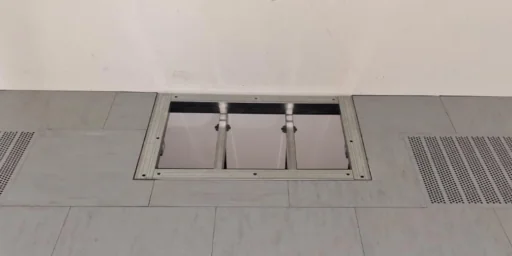
Raised access floors and installation floors have many applications, including data and server rooms, laboratories, telecommunications facilities, cleanrooms, hospitals and industrial environments.

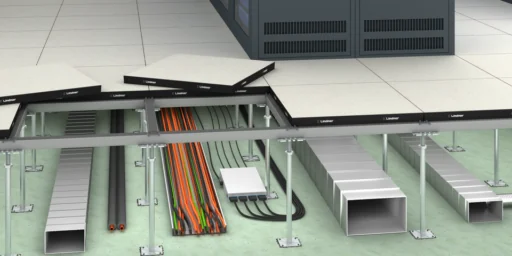
Raised access floors are commonly used to conceal pipes, cables and ventilation systems beneath the floor surface. Computers and servers generate significant heat, and cooling is often supplied through the raised floor system to ensure stable and reliable operation. Raised floors are therefore a practical solution in any environment where optimal use of floor space is required while keeping cabling, piping and technical infrastructure hidden.
Raised access floors can be finished with virtually any type of floor covering. However, ESD flooring is required in environments where ESD-sensitive electronics are manufactured, handled or serviced, as well as in explosive atmospheres, operating theatres and other sensitive environments, where electrostatic discharge could cause operational disturbances or damage electronic equipment.
Standards we follow
We follow the standards IEC 61340-5-1 and ANSI/ESD S20.20.
- IEC 61340-5-1 is primarily used in Europe and Asia
- ANSI/ESD S20.20 is primarily used in North America
The standards are largely compatible and define requirements and guidelines for ESD protection, including flooring requirements.
ESD floor coverings are defined by electrical resistance (ohms).
The maximum resistance to ground is specified as:
Rg < 1 × 10⁹ ohm (1 GΩ)
When the floor covering is used to ground personnel, the maximum allowable body voltage is < 100 V.
Types of flooring
Floor coverings are typically divided into three categories:
- Antistatic
- Electrostatic dissipative
- Electrostatic conductive
The term antistatic flooring is often misunderstood and incorrectly used.
When many people say they want an antistatic floor, they usually mean flooring in the electrostatic dissipative or conductive category, commonly referred to as ESD flooring.
Antistatic flooring
Antistatic flooring reduces triboelectric charging between footwear and the floor surface when people walk across it. This prevents unpleasant static shocks when touching objects.
However, antistatic flooring:
- cannot be grounded
- cannot remove excess static charge
Its effectiveness depends on its ability to reduce frictional charging and is strongly influenced by air humidity.
The human sensitivity threshold for static electricity is approximately 3000 V, meaning antistatic flooring mainly prevents discomfort rather than protecting electronics.
Antistatic flooring is not suitable in environments where:
- ESD-sensitive electronics are handled
- explosive atmospheres are present
In such environments, grounded ESD flooring must be used.
ESD flooring
ESD flooring belongs to the electrostatic dissipative or conductive category and must be properly grounded.
Typical environments include:
- electronics manufacturing and service facilities
- telecommunications installations
- IT and data centres
- hospitals
- technical cleanrooms
- X-ray / MRI rooms
- laboratories
Although the terms dissipative and conductive are no longer used directly in modern ESD standards, they remain common in the flooring industry.
Electrical resistance values
Electrostatic dissipative flooring
Rg between
1 × 10⁶ ohm (1 MΩ) – 1 × 10⁹ ohm (1 GΩ)
Electrostatic conductive flooring
Rg
< 1 × 10⁶ ohm (1 MΩ)
In most cases, dissipative flooring offers the same advantages as conductive flooring.
However, in explosive environments, faster discharge times are required, which may make conductive flooring necessary.
Personnel grounding and system resistance
In electronics manufacturing and other sensitive environments, the maximum allowable body voltage is < 100 V, according to the standards mentioned above.
This is difficult to achieve without mandatory ESD footwear or heel straps.
The concept of system resistance is used to describe the total resistance to ground measured from a person to ground through:
- footwear
- flooring system
Maximum permitted system resistance:
< 3.5 × 10⁷ ohm (35 MΩ)
Both mathematical models and practical testing show that body voltage will remain below 100 V if the system resistance stays below this level.
Floor coverings with resistance values between:
35 MΩ < Rg < 1 GΩ
may also comply with the <100 V requirement if verified through a standardised Walking Test, which simulates realistic movement across the floor surface.
Humidity also influences performance:
- Low humidity reduces conductivity
- Higher humidity improves conductivity
Flooring selection in uncontrolled environments
In environments where ESD footwear cannot realistically be required, it is particularly important to consider more than just the floor’s resistance to ground.
A floor covering with lower resistance is not necessarily better than one with higher resistance (for example 10⁸ vs 10⁹ ohm).
In uncontrolled environments, triboelectric charging between footwear and flooring can be the decisive factor.
Always review the manufacturer’s technical data sheet and avoid selecting flooring based on a single parameter.
In general:
Rubber-based flooring generates less static charge than vinyl flooring.
Safety considerations
For safety reasons, a minimum resistance level must also be maintained to avoid hazardous electrical shocks if someone accidentally contacts mains voltage.
A minimum resistance of
Rg ≥ 1 × 10⁵ ohm (100 kΩ)
is recommended.
Personnel safety must always take priority.
Grounding of ESD flooring
Electrostatic dissipative or conductive flooring tiles must be grounded via the raised floor steel structure in order to function correctly.
ESD tiles are glued to floor panels (for example Gammacore panels) using electrically conductive adhesive.
The panels are electrically connected to the steel support structure via the steel plates on the underside of the panels.
The flooring system must have at least one connection to electrical earth per 100 m².
The steel substructure is often already connected to electrical ground for other technical reasons. If not, grounding can easily be performed by a qualified electrician.
Important installation requirements:
Installation must follow the flooring manufacturer’s instructions
The adhesive must be at least as conductive as the ESD tiles
The adhesive must retain its conductivity over time
Electrical continuity between tiles and steel structure must be verified